

To install a font, unzip the download, find the .otf or .ttf file inside, and open it. On Windows you right-click and choose Install. On a Mac you double-click and press Install. Then restart the app you want to use it in. That's it. The whole thing takes about a minute.
I've been designing and installing fonts for 15 years, and I still get emails from people whose new font "isn't working". It's nearly always one of three things: the file is still zipped, the app wasn't restarted, or it's a web font. This guide walks through every step for every system, so you won't hit any of them.
The short version
| Windows 11 / 10 | Unzip → right-click the .otf/.ttf → Install |
|---|---|
| Mac | Unzip → double-click the font → Install in Font Book |
| Linux | Double-click → Install, or copy to ~/.local/share/fonts and run fc-cache -f |
| iPhone / iPad | Install a font app from the App Store, then add the font through it |
| Android / Chromebook | No system-wide install; add fonts inside apps that support it |
- Before you start
- Windows
- Mac
- Linux
- iPhone & iPad
- Android
- Chromebook
- Using it in apps
- Not showing up?
- FAQ
Before You Start: Get the Right File
Fonts usually arrive as a ZIP file. Inside you'll find the font files plus some extras, like a licence and maybe a read-me. You only need the font files. If you're new to all this, my post on what a font is covers the basics.
Step 1: Unzip it
- Windows: right-click the ZIP → Extract All → Extract. A normal folder appears next to it.
- Mac: double-click the ZIP. It unzips into a folder in the same place.
- Linux: right-click → Extract Here, or run
unzip fontname.zip.
Don't skip this. Windows lets you open a ZIP and look at the files without extracting them, so it looks like you can install from there. You can't, reliably. The font will either fail or go missing later.
Step 2: Pick the right file type
| File ends in | What it is | Install it? |
|---|---|---|
| .otf | OpenType. The modern standard, with extras like ligatures and alternate letters | Yes, your first choice |
| .ttf | TrueType. Older, but works everywhere | Yes, if there's no OTF |
| .ttc / .otc | A collection of several fonts in one file | Yes |
| .woff / .woff2 | Web fonts, made for websites | No, look for the desktop version |
| .eot / .svg | Old web formats | No |
If a family comes in both OTF and TTF, install one or the other, not both. Two copies of the same font with the same name confuse apps and can show the wrong one. You'll often get a whole family too (Regular, Bold, Italic and so on). Install all of them, so the bold and italic buttons in your apps use the real designed weights instead of faking them. If there's a variable font (often with "Variable" or "VF" in the name), that one file contains every weight.
Tip: install several fonts at once by selecting them all (Ctrl+A on Windows, ⌘+A on Mac) and installing them together.
How to Install a Font on Windows 11 and 10
There are three ways to do it. They all give the same result, so use whichever feels easiest.
Method 1: Right-click and install (quickest)
- Open the unzipped folderFind the
.otfor.ttffile. If you can't see file extensions, the icon with a page and a big "A" is the one. - Right-click the font fileOn Windows 11, if you don't see Install straight away, click Show more options at the bottom of the menu.
- Choose Install or Install for all usersInstall adds it just for your account. Install for all users adds it for everyone on the PC and asks for admin permission. Some older programs only see fonts installed for all users, so pick that if you can.
- Restart your appClose and reopen Word, Photoshop or whatever you're using. The font is now in its font list.
Method 2: Double-click and preview
- Double-click the font fileA preview window opens showing the font at different sizes.
- Click InstallIt's at the top left. The button greys out once it's done.
Method 3: Drag and drop in Settings
- Open Settings → Personalization → FontsOr press Win and type "fonts".
- Drag the font files onto the "Drag and drop to install" boxThis is handy for installing lots of fonts at once. The same page lets you search, preview and uninstall fonts later.
Where Windows puts fonts: C:\Windows\Fonts for all users, and C:\Users\YourName\AppData\Local\Microsoft\Windows\Fonts for fonts installed just for you. You don't need to go into these folders yourself, but it's useful to know if you're backing fonts up or moving them to a new PC.
How to Install a Font on a Mac
Macs use an app called Font Book, which comes with macOS. It works the same on every recent version, from Big Sur through to the latest.
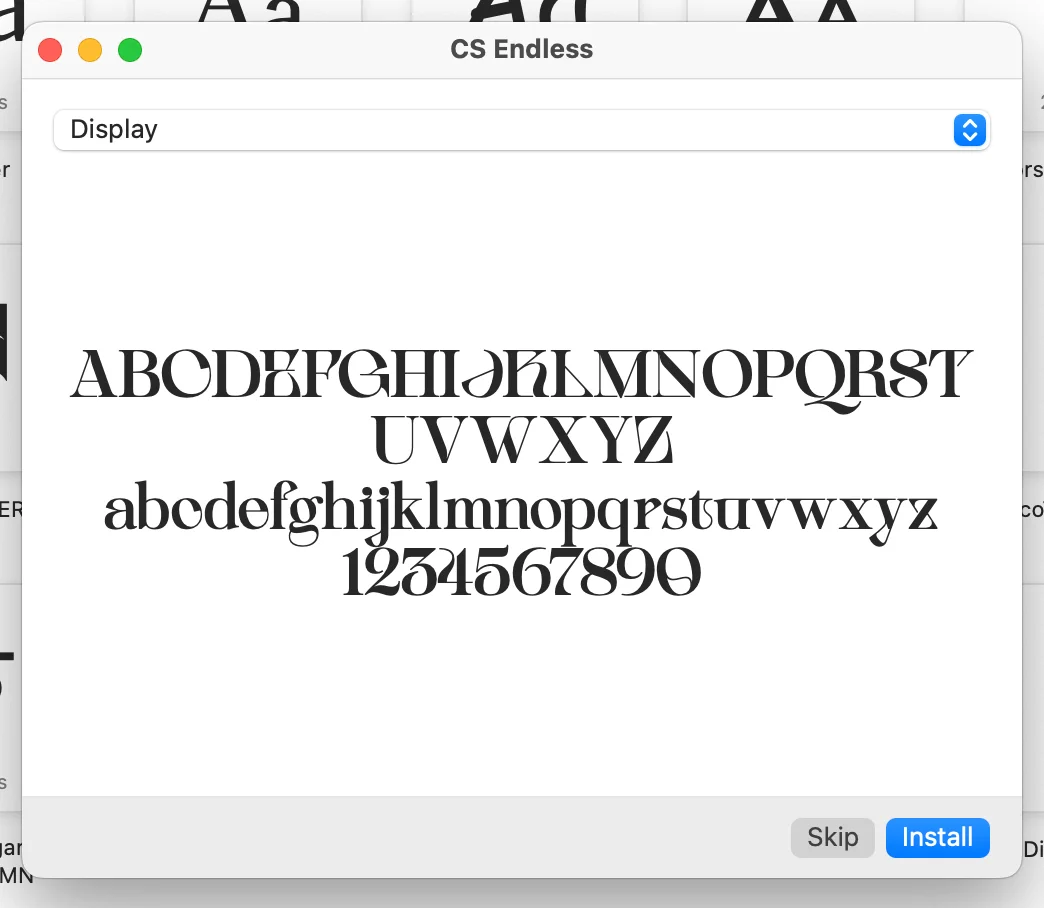
- Double-click the font fileFont Book opens a preview of the font.
- Click InstallBottom right. Font Book checks the file for problems first. If it warns you, see the troubleshooting section below.
- Restart your appQuit fully with ⌘+Q (closing the window isn't enough), then reopen it. The font will be in the font menu.
Installing lots of fonts at once
Open Font Book (press ⌘+Space and type "Font Book"), then drag a whole folder of fonts into the window. It installs everything inside.
Install for just you, or for everyone?
By default, fonts go in your own fonts folder, ~/Library/Fonts. To make them available to every account on the Mac, open Font Book → Settings and change the default install location to All Users (it asks for your password). Everyone's fonts live in /Library/Fonts.
To find your own fonts folder in Finder, press ⌘+Shift+G and type ~/Library/Fonts. The Library folder is hidden by default, which is why people can never find it.
How to Install a Font on Linux
Most desktop Linux setups have a graphical way to do this, so you don't need the terminal unless you want it.
The easy way (Ubuntu, Fedora, Mint and most others)
- Double-click the font fileOn GNOME (Ubuntu, Fedora) it opens in the Fonts app. On KDE Plasma it opens in KFontView. On Linux Mint it opens in the font viewer.
- Click InstallThe font is copied into your personal fonts folder.
- Restart your appLibreOffice, GIMP, Inkscape and the rest will now list it.
The terminal way (works on any distro)
To install a font for just your user, no sudo needed:
mkdir -p ~/.local/share/fonts
cp ~/Downloads/MyFont/*.otf ~/.local/share/fonts/
fc-cache -f
To install it for every user on the machine:
sudo mkdir -p /usr/local/share/fonts/myfont
sudo cp ~/Downloads/MyFont/*.otf /usr/local/share/fonts/myfont/
sudo fc-cache -f
Then check it worked:
fc-list | grep -i "myfont"If the font name prints out, it's installed. Use /usr/local/share/fonts rather than /usr/share/fonts for your own fonts, since your package manager looks after the second one and may overwrite things there. You may still see older guides using ~/.fonts. It still works, but ~/.local/share/fonts is the current standard.
How to Install a Font on iPhone and iPad
iOS and iPadOS don't let you open a font file and install it directly. Instead, fonts are installed through an app.
- Get a font installer appSearch the App Store for "font installer". If you use Adobe Fonts, the Adobe Creative Cloud app can install those for you.
- Add your font file to the appUsually by importing it from the Files app, iCloud Drive or a download.
- Approve the installThe app asks for permission, then the font appears in Settings → General → Fonts.
Installed fonts work in apps that support custom fonts, like Pages, Keynote, Procreate and Affinity. They won't change your phone's system font, and some apps simply ignore them.
How to Install a Font on Android
Android doesn't support installing fonts system-wide. You have two options:
- Inside an app: many design apps, like Canva, PicsArt and Phonto, let you import a
.ttfor.otffile for use in that app. This is the one to use for designing. - Change the system font: some phones, especially Samsung Galaxy models, let you change the font used across the phone in Settings → Display → Font size and style, using fonts from the Galaxy Store. You can't use your own font files this way without third-party tools.
How to Install a Font on a Chromebook
ChromeOS doesn't let you install fonts for the whole system either. Your options:
- Google Docs and Slides: click the font menu → More fonts to add any of the hundreds of Google Fonts.
- Web apps like Canva: upload your font inside the app (Canva needs a Pro account for this).
- Linux apps: if you've turned on Linux on your Chromebook, follow the Linux steps above. Fonts installed this way only work in Linux apps like GIMP or LibreOffice, not in Chrome.
How to Use Your New Font in Word, Photoshop, Canva and More
Installing the font is half the job. Here's how to actually use it:
| App | How to use your installed font |
|---|---|
| Microsoft Word, Excel, PowerPoint | Restart the app, then pick the font from the font menu on the Home tab. To share a document with someone who doesn't have the font, go to File → Options → Save → Embed fonts in the file (Windows). |
| Photoshop, Illustrator, InDesign | Restart the app and choose the font from the Character panel. Type its name into the font box to find it quickly. |
| Pages, Keynote, TextEdit | Available as soon as the font's installed. Restart the app if it doesn't appear. |
| Figma (browser) | Install the Figma font installer from Figma's website so the browser can see your local fonts. The desktop app does this automatically. |
| Canva | Canva can't see fonts installed on your computer. With Canva Pro, upload the font file under Brand → Brand Kit → Fonts. |
| Google Docs | Can't use installed fonts at all. Use More fonts to pick from Google Fonts instead. |
| Cricut Design Space | Uses your system fonts. Install the font, restart Design Space and pick it under the System fonts filter. |
Font Not Showing Up? Here's How to Fix It
Work through these in order. The first one fixes it nine times out of ten.
- Restart the app properly. Most apps only load fonts when they open. Quit fully (not just close the window) and reopen. If that doesn't work, restart the computer.
- Search for the family name, not the file name. A file called
CSNoire-Bold.otfappears in menus as "CS Noire", with Bold as a style under it. - Make sure you unzipped it. If you installed from inside a ZIP on Windows, uninstall, extract the folder properly, and install again.
- Check it's not a web font.
.woffand.woff2files won't work in desktop apps. - Windows: install for all users. Some older programs only look in
C:\Windows\Fonts. Right-click → Install for all users. - Mac: check it's turned on. In Font Book, a greyed-out font labelled "Off" is disabled. Right-click it → Activate.
- Mac: Font Book shows a warning. A minor warning is usually fine to install anyway. A "serious error" means the file is damaged, so download it again.
- Remove duplicates. If you have both the OTF and TTF of the same font, or an old version, uninstall all copies and install just one.
- Linux: refresh the font cache. Run
fc-cache -fand restart the app. - Re-download the file. If the download was interrupted, the font may be corrupted. Get it from the original source again.
Nearly every "my font won't work" problem comes down to an app that wasn't restarted, a file that wasn't unzipped, or a web font in a desktop app.
How to Uninstall a Font
- Windows: Settings → Personalization → Fonts → click the font → Uninstall.
- Mac: open Font Book, select the font, press Delete and confirm. It goes to the Bin.
- Linux: delete the file from
~/.local/share/fonts(or the font viewer's remove button), then runfc-cache -f.
Never delete fonts your system came with, such as Segoe UI on Windows or Helvetica and San Francisco on a Mac. Menus and apps rely on them.
A Quick Word on Licences
Every font comes with a licence, including free ones. Plenty of free fonts are personal use only, which means you can't use them in a logo, on products you sell or in client work without buying a commercial licence. Check the licence file in the ZIP before you use a font for anything you'll make money from. All Cedilla fonts come with a clear licence covering commercial use. And if you're hunting for free fonts to try, my pick of the best free fonts is a good place to start.
Frequently Asked Questions
Should I install the OTF or the TTF version of a font?
Install OTF if it's there. OpenType fonts can hold more characters and features like ligatures and alternates. TTF works everywhere too, so if that's all you have, use it. Don't install both versions of the same font, because they clash.
Can I install a font straight from the ZIP file?
No. Unzip it first. Windows lets you peek inside a ZIP, but installing from there often fails or leaves the font broken once the ZIP is moved. On a Mac, double-clicking the ZIP unzips it automatically.
Where are fonts stored on my computer?
On Windows, C:\Windows\Fonts for all users and C:\Users\YourName\AppData\Local\Microsoft\Windows\Fonts for just you. On a Mac, ~/Library/Fonts for you and /Library/Fonts for everyone. On Linux, ~/.local/share/fonts for you and /usr/local/share/fonts for everyone.
I installed a font but it's not showing up. What do I do?
Fully quit and reopen the app you want to use it in, since most apps only load fonts at launch. If it's still missing, try Install for all users on Windows, check the font isn't switched off in Font Book on a Mac, or run fc-cache -f on Linux. Search for the font's family name rather than the file name. The troubleshooting section has the full checklist.
Can I use WOFF or WOFF2 files on my computer?
Not really. WOFF and WOFF2 are web fonts for websites. Desktop apps need OTF or TTF. Most font downloads include a desktop version, so look for that.
How do I use a downloaded font in Word, Photoshop or Canva?
Word and Photoshop use the fonts installed on your computer, so install the font, restart the app and choose it from the font menu. Canva and Google Docs run in the browser and can't see your installed fonts. Canva Pro lets you upload a font through Brand Kit; Google Docs only offers its own font list.
How do I uninstall a font?
On Windows go to Settings → Personalization → Fonts, click the font and choose Uninstall. On a Mac open Font Book, select the font and press Delete. On Linux delete the file from your fonts folder and run fc-cache -f.
Are free fonts safe to install?
Font files themselves are safe when they come from a trusted source such as the foundry, Google Fonts or a reputable marketplace. Be wary of sites that make you run an .exe or installer app to get a font. A real font is just a .otf or .ttf file.
Do I need a licence to use a font?
Every font comes with a licence, even free ones. Many free fonts are for personal use only, so check the licence before using one in a logo, product or client work.
Ready to Try It?
Now you know how to install a font on anything, the fun part is picking one. If you want something with real character to test your new skills on, take a look at CS Noire, a variable sans serif that packs every weight into a single file, or CS Defiant for bold display headlines.